A Gold Samovar in the Window: Dammann Frères, Strasbourg
A gold samovar, Strasbourg’s own Thé de la Cathédrale, and France’s oldest tea house: a window-shopping stop at Dammann Frères in Strasbourg.
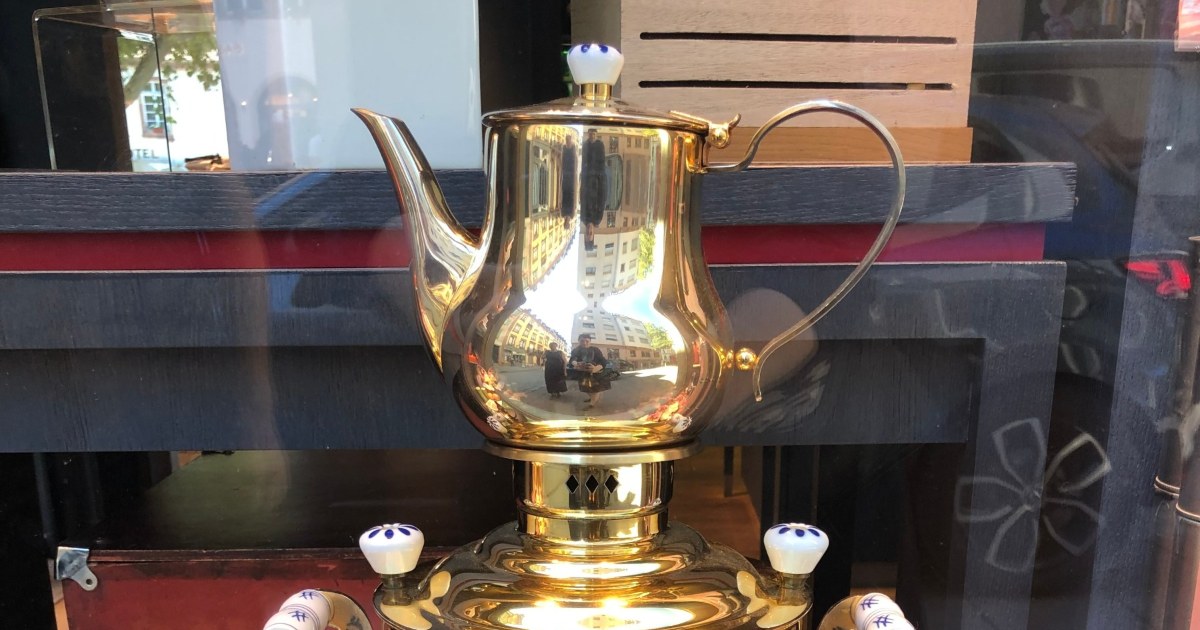
Some tea shops you walk into. This one stopped me on the pavement. In the window of Dammann Frères in Strasbourg sat a samovar polished to a mirror, gold from its clawed feet to the teapot perched on its crown, with blue-and-white porcelain handles like a Delft plate. If you look closely at the teapot, you can see the street behind me, the half-timbered façades, and me holding the phone.
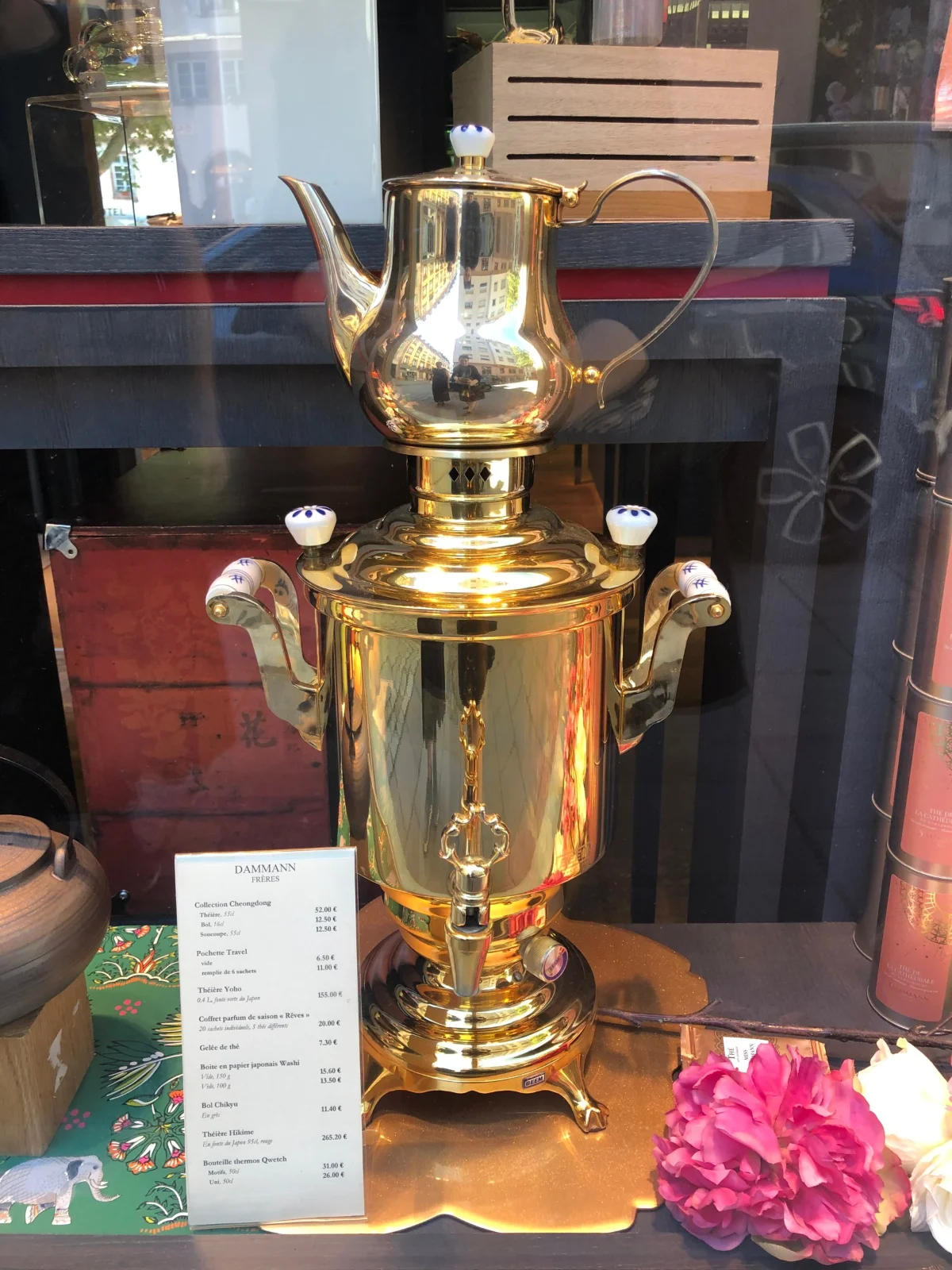
I’ll be honest: this photo comes from the archives. Dammann Frères was on my list for a trip to Strasbourg years ago, and in the end all I could do was window-shop. So I never got to taste Thé de la Cathédrale, but a shop window can tell you a lot about a tea house, and this one has stayed with me ever since.
Is Dammann Frères France’s oldest tea house?
Yes, by its own history. In 1692 Louis XIV granted a merchant, the Sieur Damame, the exclusive privilege to sell tea in France, and Dammann Frères traces itself back to that privilege. More than three centuries later it is still a tea house first: teas bought from the growing regions, blended and packed in its workshops in Dreux, west of Paris, and sold in the black tins you see in hotels across France. Its flavourists have created around 3,000 recipes, and its first boutique of its own only opened in Paris in 2008.
Its best-known blend has a love story behind it. In the 1950s the head of the house, Jean Jumeau-Lafond, noticed that his Russian-born wife, Véra, liked a slice of orange in her Earl Grey. He layered Earl Grey with blotting paper sprayed with sweet orange oil in a wooden tea chest in his sons’ bedroom, opened it a few days later, and named the result Goût Russe Douchka, from a Russian word for “my beloved”. With a Russian tea in the catalogue, a samovar in the window suddenly makes a lot of sense.
What is Thé de la Cathédrale?
Thé de la Cathédrale is Dammann Frères’ Strasbourg tea, created in 2015 to celebrate 1,000 years since work began on the city’s red sandstone cathedral in 1015. It is a green sencha flavoured with orange and clementine oils, cherry and honey, with a touch of cinnamon, which reads like a Christmas market in a cup. When it launched, the house gave one euro per box to the Fondation du Patrimoine for the cathedral’s restoration. It comes in an 80 g tin, and it is the one I most wanted to take home.
What is a samovar?
A samovar is a tall urn that keeps water hot for hours. A small teapot of very strong tea concentrate sits on top, warmed by the rising heat. Each cup gets a splash of concentrate and is topped up with hot water from the tap, so everyone can drink it as strong or as light as they like. It is the centre of the table in Russia, Iran, Turkey and much of Central Asia. The one in this window is an electric model by the German maker BEEM, the modern descendant of the charcoal-burning originals.
How it works
Anatomy of a samovar
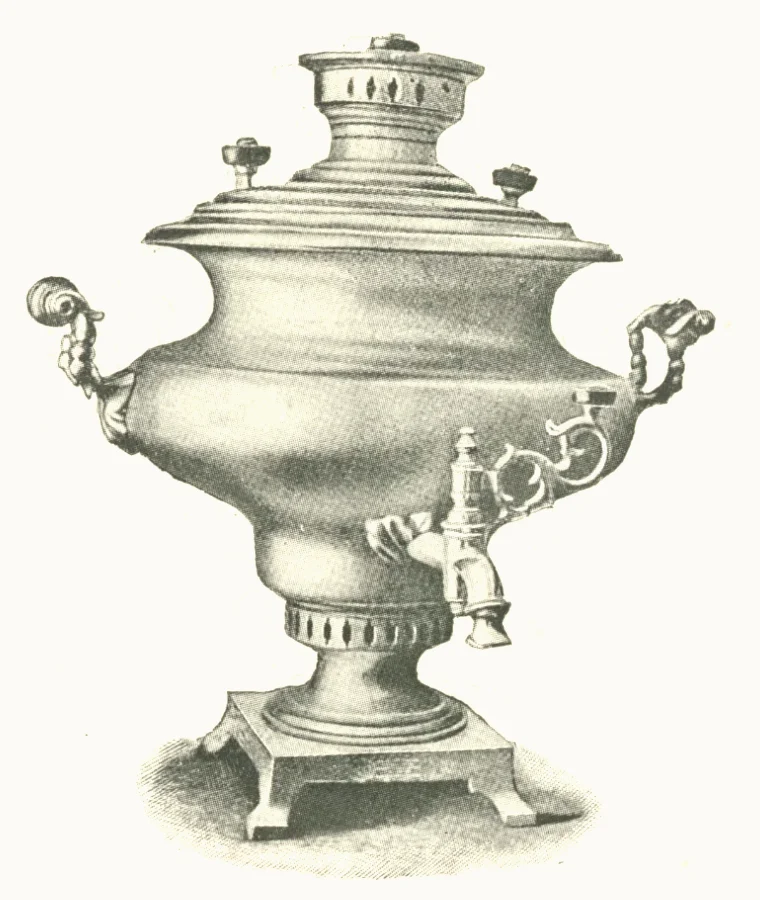
- ICrown and teapotThe zavarka, a small pot of very strong tea, sits on the crown and stays warm in the rising heat.
- IIUrnHolds litres of water near the boil for hours, enough for a long evening at the table.
- IIITapEach glass gets a splash of zavarka, then hot water from the tap, as strong or as light as you like.
- IVChimney or elementCharcoal burned in a central chimney in the originals; modern ones like the BEEM in the window heat electrically.
If samovars catch your eye too, I gathered more of them, with glass holders and silver tea sets, in Russian tea antiques, and the ritual around them in Russian tea culture.
The rest of the window
Around the samovar the shop had laid out its season: a cast-iron Japanese teapot, a Korean-inspired Cheongdong teapot and bowl set, washi paper tea boxes, tea jelly, travel pouches, a “Rêves” gift box of twenty sachets, and stacks of Thé de la Cathédrale tins. It was less a display of products than a small map of where tea is drunk, from Kyoto to Seoul to Moscow, laid out a few steps from a French cathedral.
Where are the Dammann Frères shops in Strasbourg?
Pair the shop with a slow loop from the cathedral down to the canals of Petite France, and go inside, which I never did. If you try Thé de la Cathédrale, tell me what it tastes like.
Frequently asked questions
There are two shops: Strasbourg Cathédrale at 19 rue des Orfèvres, a few steps from the cathedral, and Strasbourg Petite France at 48 rue du Fossé des Tanneurs.
Dammann Frères’ Strasbourg tea: a green sencha flavoured with orange, clementine, cherry, honey and a touch of cinnamon, created in 2015 for the 1,000th anniversary of Strasbourg Cathedral. It is sold in 80 g tins.
It traces its history to 1692, when Louis XIV gave the Sieur Damame the exclusive privilege to sell tea in France, and it presents itself as France’s oldest tea house.
Dammann Frères’ best-known blend: Earl Grey style black tea with bergamot and sweet orange, created in the 1950s and named for Véra Jumeau-Lafond, who liked a slice of orange in her tea. Douchka means “my beloved” in Russian.
A tall urn that keeps water hot for hours, with a small teapot of strong tea concentrate on top. Each cup gets a splash of concentrate topped up with hot water from the tap.
Read next
- Le Comptoir Florian, Brussels — another old European tea house
- Russian tea antiques — samovars, glass holders and silver
- Russian tea culture — history and samovar traditions
New here? Start Here for the shortest path through the blog.