Tea vs Cha: Why the World Says Tea, Cha or Chai (Map)
First published September 2018. Updated October 2026 with a new map, the story behind each word, the exceptions, and books for going further.
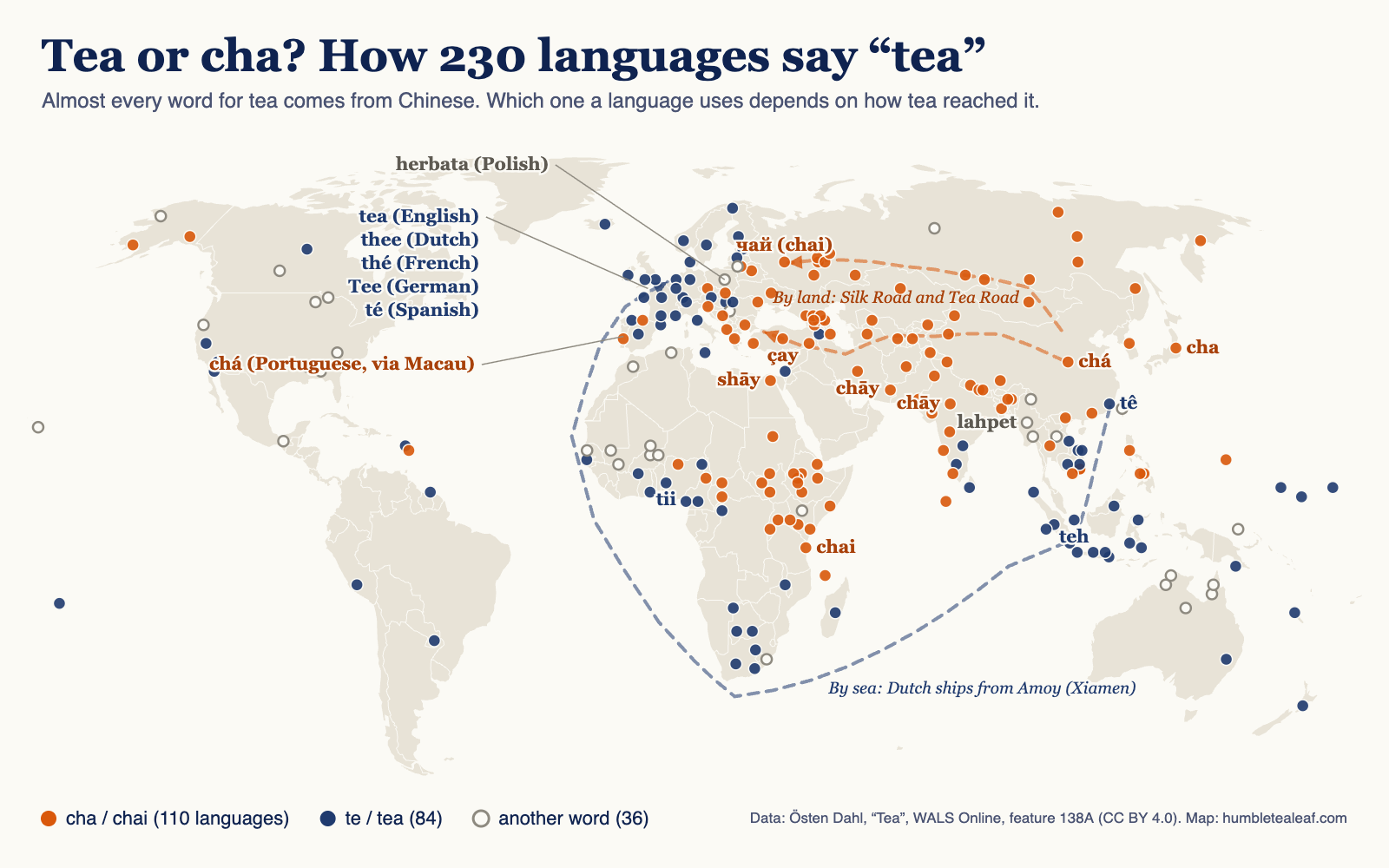
Tea and cha are the same word. Both come from the Chinese character 茶, which is pronounced te in the Min Nan dialect of coastal Fujian and cha in Mandarin and Cantonese. Languages that first met tea by sea, through Dutch traders in Fujian, say some form of te. Languages that met it overland along the Silk Road, or through the Portuguese in Macau, say cha or chai.
I first wrote about this in 2018, after seeing a map Quartz shared about it. As someone who grew up hearing “чай” in Russian, it suddenly made perfect sense to me. This version goes further: a map of 230 languages, where each word came from, the languages that say neither, and where to read more.
Tea by sea: the Dutch and the port of Amoy
In the Min Nan (Hokkien) dialect spoken around Xiamen, the port Europeans called Amoy, 茶 is pronounced tê. Dutch traders of the East India Company bought their tea through Amoy and through Malay-speaking ports such as Bantam on Java, where the word was teh. From the early 1600s the Dutch were Europe’s main tea importers, so their word, thee, travelled with the tea.
That is why most of Western Europe says some form of te: English tea, French thé, German Tee, Spanish té, Italian tè, and the Scandinavian te. Malay and Indonesian teh come straight from the same coast. Later, English spread its own version around the world, which is why Yoruba in Nigeria says tii.
English pronunciation changed along the way. Early English rhymed tea with “obey”, and that older sound still survives as “tay” in some dialects.
Cha by land: the Silk Road and the Tea Road
Most of China says chá. That form travelled west along the overland caravan routes to Central Asia and Persia, where it became chāy. From Persian it passed into Turkish çay, Arabic shāy, Hindi chāy, Swahili chai and many others.
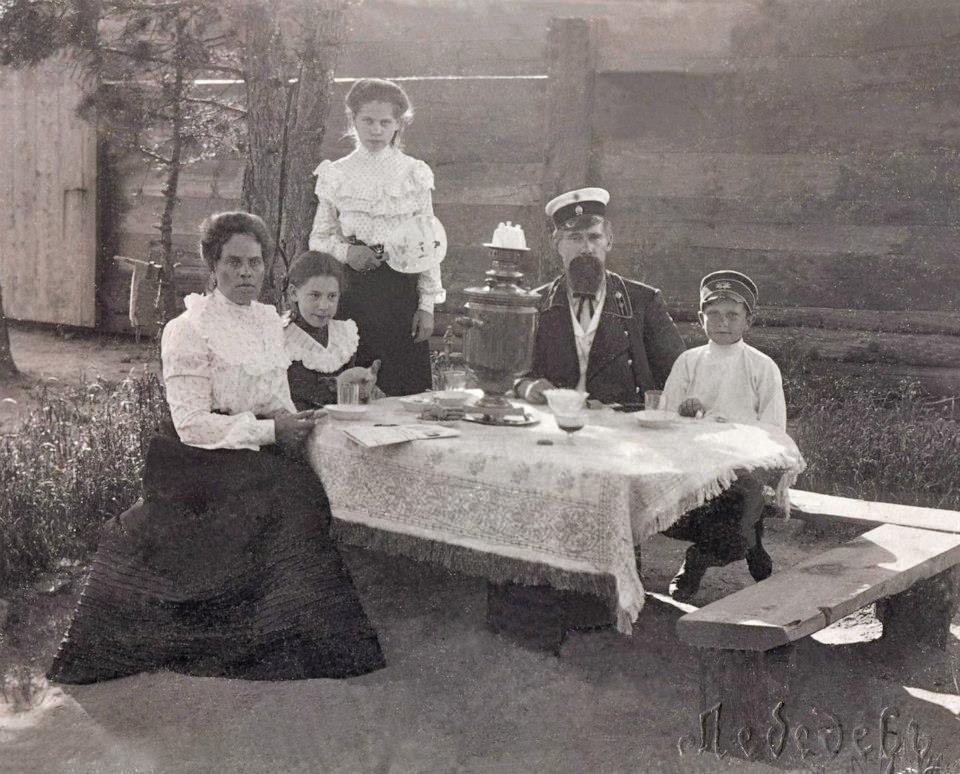
Russia got its tea overland too, so Russian says чай (chai). The first tea reached the tsar in 1638, as a gift from a Mongol khan, and the Russian envoy who carried it home nearly refused the unfamiliar leaves. After the Treaty of Kyakhta in 1727, tea came by camel caravan across Mongolia along what became known as the Tea Road, a journey that could take more than a year. Legend says the tea picked up smoke from the caravans’ campfires, which is the idea behind Russian Caravan blends. I wrote more about what happened next, from samovars to tea with jam, in Russian tea culture and Russian tea antiques.
Japan and Korea received tea and its word directly from China: tea reached Japan around 800 CE, and both languages say cha.
English has both: it took tea from the Dutch, then borrowed chai in the 20th century, and in English chai now usually means spiced milk tea.
The exceptions that prove the rule
- Portuguese chá. Portugal traded by sea but says cha. The Portuguese were the first Europeans to bring tea home, in the 1500s, and they traded through Macau, where Cantonese is spoken and the word is cha. Brazil says chá for the same reason.
- English once said cha. English recorded chaa in the 1590s, decades before tea arrived through Dutch in the 1650s. The British slang a cup of char is the same old word.
- Polish herbata. Polish, Lithuanian (arbata) and Belarusian (harbata) say neither. The word is usually traced to the Latin herba thea or Dutch herba thee, “tea herb”, so the te is hiding at the end.
- The tea plant’s homeland. In Myanmar, northern Thailand and Laos, where tea grows wild, older local words survive: Burmese lahpet means pickled tea leaves, and Thai miang is fermented tea for chewing.
- South India. Tamil tēnīr and Telugu tēnīru are “tea water”, built from te plus the local word for water.
Tea vs cha around the world, at a glance
| Language | Word for tea | Family |
|---|---|---|
| English | tea | te |
| Dutch | thee | te |
| French | thé | te |
| German | Tee | te |
| Spanish | té | te |
| Italian | tè | te |
| Finnish | tee | te |
| Malay / Indonesian | teh | te |
| Mandarin Chinese | chá | cha |
| Portuguese | chá | cha |
| Japanese | cha / ocha | cha |
| Korean | cha | cha |
| Russian | чай (chai) | cha |
| Persian | chāy | cha |
| Turkish | çay | cha |
| Arabic | shāy | cha |
| Hindi | chāy | cha |
| Swahili | chai | cha |
| Polish | herbata | neither |
| Burmese | lahpet | neither |
Across the 230 languages in the map, 110 use a cha form, 84 use a te form and 36 use another word.
Before tea and cha: the character 茶
The character 茶 itself is fairly young. In earlier Chinese, tea shared a character, 荼 (tú), with a bitter vegetable. During the Tang dynasty one stroke was dropped to make 茶, the form Lu Yu used in his Classic of Tea, written around 760 CE. I wrote more about Lu Yu in my list of the best books on tea history, and about where tea began in tea, the Dao and spiritual thought.
Books and resources for going further
Books
- The True History of Tea by Victor H. Mair and Erling Hoh (2009). Mair is a scholar of Chinese language who has written widely about the words for tea, so it is strong on how the words travelled with the leaves.
- The Tea Road: China and Russia Meet Across the Steppe by Martha Avery (2003). The overland caravan route that gave Russian its чай.
- For All the Tea in China by Sarah Rose (2010). How Robert Fortune smuggled tea plants out of China for the British East India Company.
- A Thirst for Empire: How Tea Shaped the Modern World by Erika Rappaport (2017). Tea, trade and empire, from the 1600s to today.
- The Classic of Tea by Lu Yu, translated by Francis Ross Carpenter. Where tea writing began. See my five favourite tea history books.
Online
- “Tea”, by Östen Dahl, in the World Atlas of Language Structures: the study behind the map, with the data for all 230 languages.
- Etymology of tea on Wikipedia: the word in dozens more languages.
- “Tea” in the Online Etymology Dictionary: the English story, from chaa to tay to tea.
- Words for tea in the Caucasus, at Language Log, the linguistics blog.
For the Russian side of the story, see my posts on Russian tea culture, Russian tea antiques and Sagan Dalya, the Siberian mountain tea.
Frequently asked questions
Both words come from the same Chinese character, 茶, which is pronounced te in the Min Nan dialect of Fujian and cha in Mandarin and Cantonese. Languages that first got tea by sea through Dutch traders in Fujian took te; languages that got it overland, or through the Portuguese in Macau, took cha.
Yes. Chai comes from Persian chāy, which came from Chinese cha along the overland trade routes. From Persian it spread to Russian, Turkish, Arabic, Hindi, Swahili and many other languages.
The Portuguese traded through Macau in the 1500s, where Cantonese is spoken and the word is cha. The Dutch, who spread te across Europe, traded with ports in Fujian, where the word is te.
Yes. English recorded chaa in the 1590s, before tea arrived through Dutch in the 1650s. The British slang char, as in a cup of char, also comes from cha.
Read next
- The ancient tea trees of Yunnan — where Chinese tea’s oldest living history still grows
- Taiwan’s high mountain oolong — the hidden story of gaoshancha
- 5 good books about tea history — where to go deeper
New here? Start Here for the shortest path through the blog.